Showing posts with label role models. Show all posts

November 09, 2007

Childless and Mormon

Oprah recently did a show on fundamental Mormon polygamists. The majority of women featured on the show appeared very pleased with their plural marriages and most had over five children each. I did the addition and realized there were over 20 people living together in one home. Whew…

Of course this type of marriage is rare and illegal. One notorius leader, Warren Jeffs, president of the Fundamentalist Church of Jesus Christ of Latter Day Saints and husband to over 50 wives, is currently in jail awaiting his sentence after being found guilty of accomplice to rape for coercing a 14-year-old girl into a marriage with her elder cousin.

The mainstream Mormon Church no longer sanctions polygamy, and there are only a few communities of polygamists left in North America. However, the Church continues to actively support and endorse large families, so I wondered: what is life like for childless or childfree LDS couples?

Kathryn Kidd, a childless Mormon author from Virginia and a contributor to Meridien Magazine, an ezine designed for Latter-day Saints, explored this question in a article titled Other Avenues for the Childless after being contacted by women who wrote about the challenges of childlessness.

Barbara, reflecting on her experience of a life without kids in the LDS community, had this to say:

The biggest problem was lack of any suitable role or role model for women in my position in the Church. There were no childless married women I could relate to, and a lack of friends or peers with whom I could share experience. Church meetings and classes and talks inevitably involve teachings on the family.

Many of the childfree and childless of all beliefs and faiths experience a sense of isolation and some exclusion. However, I suspect this must be harder in a community where having kids is what a contributor to the Latter-day Saint Liberation Front website called one of the "most profound and fundamental mortal obligations."


Technorati Tag:

October 05, 2007

Single, Straight, Male, w/ Vasectomy

Would you respond to someone who described himself this way in a personal ad?

According to Toby Byrum, he fits this description and he’s never been worried about meeting Ms. Right. He’s a single professional in a small community in Wyoming but he hopes to marry one day. He came to the conclusion, in his mid-twenties, that he didn’t want kids. He made the decision to have a vasectomy at 28 years old.

His story was featured recently on NBC’s Today Show. Today Show host Matt Lauer asked Byrum, with regards to dating, "How do your bring this up and how quickly do you bring this up?" Byrum responded: "The first date, if not before," he said. "I live in a small area, so some people are already aware of this. I bring it up quickly. There’s no reason to waste anybody’s time. If someone has a different idea for themselves, I don’t want to get in the way."

Lauer also asked if he ever thought about the fact that, as an only, male, child he might regret not leaving a legacy. Byrum admitted he had thought about it but thought that procreating for the sake of legacy "was too vain a reason to have kids"

As is usually the case, the viewer comments that followed the posted video clip on MSNBC are as interesting as Toby Byrum’s story. One comment in particular, disturbed me, because it came from a pychotherapist who felt compelled to do some armchair analysis, based on the 5-minute interview clip. The self-described "licensed psychotherapist in MA" wrote:

[I] can't help but wonder how much a toxic dose of narcissism fuels Todd's choice. (Baggage from childhood too much or not enough mirroring by his parents??)His choice has set the groundwork for him to focus his energy on pursuits and achievements at the expense of meaningful (and sometimes messy) relationships, but what about generativity (giving back to the world)? His choice and apparent lack of ultruism can result in a lonely old man, with nothing meaningful to review when it comes time to do his end of life stage of life emotional reflection. I do not see his sense of spirituality...is he spiritually bankrupt?
It irks me that the choice to remain childfree is still, so often, misunderstood, even by those who claim to know more than "the average bear" about the inner workings of the human psyche.

Technorati Tag:

August 31, 2007

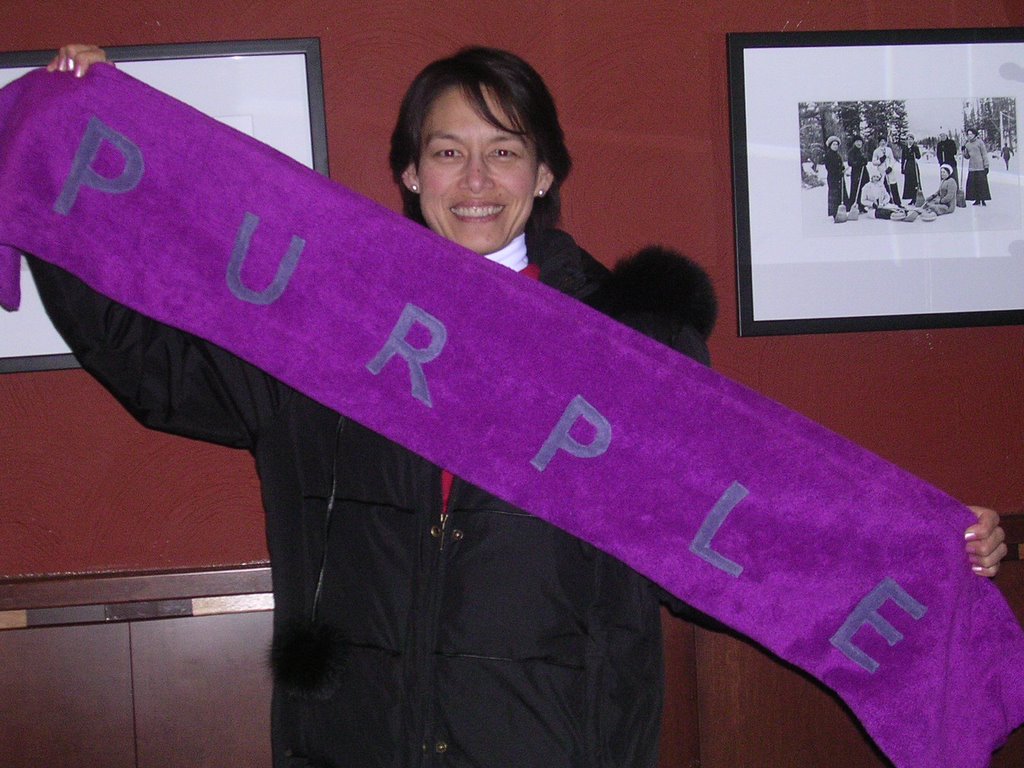
Jane is Purple!

I went to the movies with a lady friend this week. It was spontaneous and fun. Of course, we saw a "chick flick", one I could never drag my husband to. And, who knew? Not only is Jane Austen a childfree woman, she remained single all her life. Look what she was able to create!


Purple WomenTM who did not skip English Lit class in high school will already know this. Now I might have to give her a read.

Technorati Tag:

August 06, 2007

How I Became a Purple Woman

Guest Post by LynnS
Ireland

As a child, I vividly recall one Christmas in particular - for weeks beforehand, all I wanted was a Glow Worm, nothing else. (If you're a child of the 80s, you might remember!). My relatives seemed slightly puzzled by my choice. They kept asking me why I didn't want a Cabbage Patch doll or Tiny Tears, and they kept insisting I'd change my mind. I stood firm, though - I told them that I wasn't interested in "some stupid, boring doll", even though it seemed practically every girl I knew wanted one.

Imagine my disappointment, then, when I woke up on Christmas morning and found a Tiny Tears doll and no sign of a Glow Worm anywhere. Strangely, though, I wasn't surprised I'd been given a doll. I knew I was expected to play with it and at least give the appearance of loving it. You hardly need to be a psychologist to see the pattern emerging. . .

Other incidents come to mind: when my cousin gave birth to her first child, I congratulated her on the card and not her husband. My mother told me I'd forgotten to put her husband's name down and I told her I didn't. Why should I? She'd done all the hard work, not him. My mother was scandalized, of course, and insisted I add his name but I knew I was right.

I also remember when I was about twelve and letters were sent home from school about the Rubella vaccine. I asked why we needed it and when my mother explained why, I crossed my arms and earnestly pointed out that I didn't need it because I wasn't ever going to have children. (Of course, I had to have it anyway. . .)

In retrospect, it's glaringly obvious that I was what you might call an "early articulator"!
Tellingly, every time I tried to express my feelings, I was pressured, patronized and occasionally treated like I ate babies for breakfast. Unfortunately, some things are slow to change. . .

As I progressed through adolescence, I was bombarded by messages from the media and society in general that motherhood was the greatest experience a woman could have. A childless woman was ( for me anyway) rarer than a unicorn sighting. (I'd never even heard the term "childfree").

The few childfree women I knew were objects of pity and scorn, if not downright viciousness - even though they all seemed far happier than almost all the mothers I knew. From quite a young age, I sensed that the derision these women faced was prompted by jealousy yet nobody was willing to admit it.

I was old enough by then to recognize the financial and emotional strain parenting put on a person. My own mother often seemed stressed out, depressed, frustrated and resentful. I was puzzled by this: she was the first one to lash out at "career women", as they were then called, yet motherhood didn't seem to make her happy. Odd as this may sound, I was grateful things turned out that way: it forced me to open my eyes and think and decide for myself. It meant I learned to disregard society's expectations, no easy thing in staunchly Catholic Ireland in the 1980s, and understand that no one could live my life for me.

When I was 20, I started reading feminist works by authors such as Gloria Steinem, Naomi Wolf, Susan Faludi, etc. Inspiring as they were (and still are) there was still something I couldn't pinpoint until years later: even feminist writings seemed to assume that women were or would be mothers. A turning point for me came when I stumbled across a copy of Ellen Peck's The Baby Trap in a used bookstore. This book had a profound and lasting effect on me. I felt relieved, thrilled, vindicated. It confirmed what I'd always known and I was so comforted to know I wasn't alone, that there were people out there who shared my feelings. For years my not wanting children had almost felt like a dirty secret.

I was 23 when my niece was born and even though I could see the appeal of babies and why a woman would want one, I still had not the slightest desire to have one of my own. My youngest sister was born when I was 14 so I have some idea of the level of sacrifice, exhaustion, worry and expense involved.

My 30th birthday was a milestone for me, like it is for many people. It was actually quite depressing because I seemed to be the only one who wasn't a mother - it really brought home how isolated I was, even though I've never regretted my decision. Despite being on the receiving end of a few snide comments of the "just wait till you hit thirty" variety, the older I get, the more certain I am that I've made the right decision for me.

Over the years, I've gotten every bingo going - I'm sure most Purple Women will know what I mean. The one that I get most often is "it's selfish not to have children".

Ahhh, that old classic. Except it cuts no ice with me.

I tell people if they look it up in any dictionary, it'll be defined as being concerned only with one's own welfare with total disregard to others, or something similar. Exactly how does my choosing not to have children affect them? It doesn't really - except that it makes them consider their own choices. If that makes them antsy, all I can say is that they can't have been that secure about their choices in the first place.

It would be remiss of me not to mention the fact that I have wondered what will happen when I get older. Will I look back and regret not having children? I truly believe that I won't. And if I do? I would far rather regret not having children than having children and regretting it.
I never volunteer the information that I'm childfree - not because I'm embarrassed about it, but because I can't be bothered wasting energy explaining and defending my choice.
I make it a point never to ask anyone about their children or if they have any in social settings. It saddens me that in the 21st century society persists in glorifying motherhood, while women who choose not to become mothers are all too often viewed in a negative manner.

There is hope, however. I believe that generations to come will realize that parenting is a choice and not a predetermined, unalterable path. If people really think about whether or not to have children, the happier everyone will be.

Ask any Purple Woman and they'll tell you that not conforming to society's expectations can be difficult sometimes, no matter how happy you are with your decision.

Remember that the path less traveled has its own rewards.

And remember this piece of advice my grandmother gave me which I've never forgotten, and never fails to make me smile:

"If it won't make you laugh, it won't make you cry either!"

[Editor's note: AlphaGirl reviewed The Baby Trap for us last year. If you are interested in picking up a good book in the childfree genre, just click on the book review topic a little lower in the sidebar to see all our reviews. If you click on the link under the title "Feed Your Mind" and purchase your next book via Amazon.com, you will be supporting this site!]

Technorati Tag:

August 15, 2006

Purple Women in the Movies

Since starting this blog and conceiving of a book on the same subject, (yes, it is my book "baby") I have been necessarily obsessed with the state of being childfree. Not just here (I am in Canada currently), but in the world.

For some time now I have been seeking role models. I remember asking my friend's mother, our next door neighbor, "What do you do?" At first she was defensive, then she realized that I was truly asking what her life was like.

It was the early 70s and women were much in the spotlight, entering the workforce like never before and she was a stay at home mom. She may have felt out of step with the women's movement -- it's hard to tell. She proceeded to tell me what her typical week was like. My own mother worked outside the home; beyond that - she owned her own business. I was very proud of her for that, but at a certain point I realized that she was not a typical woman.

I don't think my search for role models ended there. I am always looking for women to admire and emulate, and my friends are among them. Role models often don't like to be called "role model", and they can be real or imaginary. It's hard not to look to Hollywood for some positive examples.

Here's my short list of Purple WomenTM in the movies whom I admire:

Ellen Ripley - Handles weapons and space ships with equal aplomb and knows what to do with evil aliens.

Smilla Jasperson - She is an accomplished scientist, knows more about ice and snow than the average person, she's kind to small children, and she once made a living tagging polar bears.

Catherine Banning - Drinks a strange green conconction for breakfast, likes fine art and the finer things in life, and when she sets out to catch a theif, she really goes all out.

Do you know what movies they appear in? (Answers next Tuesday unless you guess them first!)


Technorati Tag:

April 26, 2006

Wanted: Childfree Role Models

As a childfree 40-year-old, married woman I fit squarely in the category of those who are deemed to have an atypical adult identity. My husband and I live happily outside the mainstream, but at times it has been lonely. I have struggled to accept and define myself by my alternative family status. This became more of a crisis for me as more of our friends got married and had kids, thus altering their lives and our relationship with them, forever. It didn’t help that we chose to live in the burbs. Now I seek out childfree friends who have more time to socialize.

I am used to being categorized and marginalized, if not for my childfree status, then for some other reason. My husband is a baby boomer. I am Generation X, but missing the lower back tattoo and only my ears are pierced. I heard a new term on a talk radio program recently: omniracial. Omiogosh, I thought, that’s me too! I am half Cambodian with a touch of Portuguese, and on the American side Germanic and Irish decent. Okay, who wants a piece of me? I really felt for Tiger Woods when the media was going crazy over his ethnicity.

A while back, when I was still living in California I managed a swim school. It was a step off the beaten path of nonprofit fundraising for me, but I loved that job. All the kids called me Miss Teri and I got really good at guessing children’s ages, age three through nine. A close family member had encouraged me to take the job. She said, “It will be good for you to be around children and families.” She was right and this experience helped me realize that I am good with children -- something I never knew before, partly because I am an only child.

It was fun to play with other people’s kids. I think back now and realize that I was testing myself to see if being around children would drive me one way or anther, perhaps to pursue adoption or foster parenting.
The experience was a good one for me, but in the end I decided to remain childfree. The “deciding to decide” and then accepting the decision, and acting upon it, was a very important step for me.

The knowledge that I could not bear children of my own haunted me throughout my 20s and 30s, and I have struggled to find my own reason for being, my purpose in life. I have often wondered if the childfree have an important role or even a duty to society, our family and our community to give back or make a difference in some way -- since our greatest achievement will not be a child. Some would argue that not having a child is our gift to the earth.

This conversation with myself has evolved over the years. Lately, I’ve been wondering if perhaps we should be the first-responders in case of crises? I think my need for significance is why I was drawn to work in the nonprofit sector. More recently, I have come to see my childfree status an opportunity to immerse myself in what I am passionate about, so that I may leave my mark on the world (blogosphere?), even if it’s only chicken scratch!

At this mid-point in life, a time when life-review is not un-common, I am still looking around me for good role models. I have been lucky to find a few along the way.

Technorati Tags:

March 30, 2006

No Kids, No Regrets

This is my first post for the website, and my first blog, ever. With those disclaimers in mind, here is my introduction. Read on and enjoy!

When I think of being childfree, I like to think the childfree lifestyle chose me, instead of the other way around. When I look back on my "grown-up" daydreams as a kid, I realize they didn't involve having kids of my own. I dreamt of living on a ranch with a flock of animals to tend to, flowers and trees to nurture, and maybe even some horses to ride. I would spend long hours in the sun tending to my garden, and making sure all the animals were fed, loved, and healthy. I also dreamt of being a professor at nearby UC Berkeley, helping students to discover ideas that they hadn't previously considered, and contributing to the rich academic community. While I didn't grow up to own a ranch or to change the world, I have remained true to my dreams of a life unencumbered by parenting.

I rolled my eyes when neighbors would bring their babies over for a visit, and would wrinkle my nose as my friends showed off newborn siblings. No thanks, I would tell them, I don't want to hold/diaper/feed your new brother or sister. I think my mother realized very early on she wouldn't be a grandmother on my account. One afternoon, my quiet time of reading in my room was blown to bits by the paint-peeling wail of a visiting neighbor's baby. I tossed my book aside, came out into the living room, put my hands on my hips and said "Would someone please shut that baby UP?!" I spun on my Mary Janes and flounced out of the room. I was about 7. Yep, destiny taps you on the shoulder early in life and invites you to dance.

I was 11 years old when I read Ellen Peck's The Baby Trap. It blew my mind and set me free from the cultural imperative to reproduce.

As I moved forward into my 20's and 30's, I coped with the loneliness of my choice (friends were reproducing like rabbits then) and took comfort in the company of others who felt the way I did.
I read the works of Elinor Burkett, Leslie Lafayette, Mardy Ireland and other CF women who I saw to be very powerful role models. I took action and spoke out on pronatalism in our society and in the media, and the harmful messages that came with it. I have my bad days, sure. They stem from having dealt with ignorant comments/stereotypes, armchair psychoanalysis ("You don't have kids because of childhood trauma"), and other ignorant, rude behavior.

I cringe when some parents assume their familial status makes them morally superior. Hey, we all come into the world the same way: Cold, naked, and without kids. So I don't get it. In all seriousness, every day I'm grateful I listened to that scrappy kid back when who knew parenting was not for her, and I'm grateful for my choice today as a grown adult, living a life of clarity and of no regrets.

March 05, 2006

Adult Female Identity

Even at this mid-point in life, a time when life-review is common, (not always a crisis), I am still looking around me for role models, especially in the generation ahead of me, for clues to good living. We all need heroes, people we admire and want to emulate. This was a huge motivating factor in the creation of Purple Women™ – the survey, upon which my book will be based. I cannot wait to delve into the analysis.

They say “you are the company you keep” and I really believe that’s true. As a childfree 40-something, married woman I fit squarely in the category of those who are deemed to have an atypical adult identity. My husband and I live happily outside the mainstream. I wonder if I am alone in my struggle to accept and define myself by my alternative “family” status? We are a family of two, a subset of two much larger complicated families, just like everyone else, but we are not like everyone else.

Identity became more of a crisis for me after my fiancée, now my husband of 8 years, moved me back to his rural hometown right before we got married. It’s the kind of place people move to when they need a bigger house in the suburb so they can raise 2.5 children. As we started out on our co-mingled journey together, we both came to realize, albeit for different reasons, that this was not the right place for us. I am glad to have had the experience. I feel I know him better for it, but I am also glad we moved on. Culturally and socially I was dying.

Over the years I have tried to define myself by my work, with so-so results. I figured, it works for men, so why not me? I got a little panicky when I would think about “my career”. I thought that since I was going not to be a mom that I had to do or be something else. I think deep down I viewed myself through how I feared other people would judge me. That I had no worth if I was not a mom, or otherwise contributing to the economy, or making a difference in the world. This is probably psychological fallout from living in a kid-centric society. I found some solace in focusing the last decade of my work life in the nonprofit sector and as a fundraiser for good causes – both as volunteer and paid staff.

When the opportunity came up to move across three time zones and one border on a company transfer, I really pushed for it. I saw it as a chance to start over, and think through just what kind of life we wanted to build. When we got posted in Canada, I was determined to seek friends who were childfree and had time for extracurricular activities and socializing. It has made all the difference.